 |
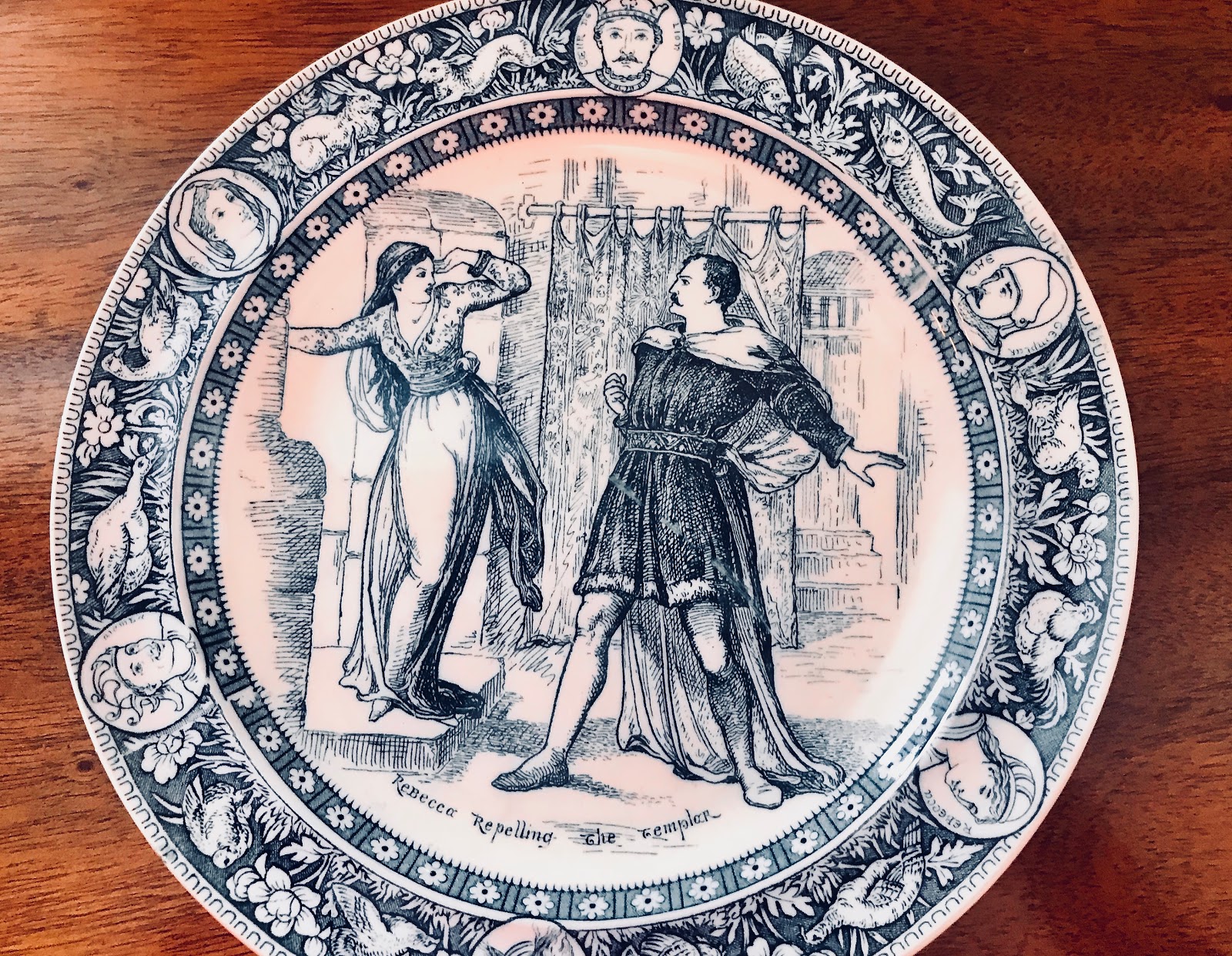
| "Rebecca and the Templar" 10" dinner plate Ivanhoe pattern, Wedgwood, 1880
Rebecca Gratz was celebrated in her lifetime and revered after her death as the inspiration for the character of Rebecca, the beautiful Jewish girl in Walter Scott's historical novel Ivanhoe. As such she became a role model for Jewish women and a figure of romance to the larger community.
The problem today with discussing her association with the character is that no one has read Ivanhoe in 50 years. Even though some are still familiar with the title and can recall it as a story about medieval England, their knowledge comes from a film version rather than the book itself. No one has firsthand experience of the Rebecca of the novel and we are too far away from Ivanhoe's publication date to have any idea of the impact it had on 19th-century readers. So, before we look into the Gratz link, we have to understand how a novel could have the power to change a woman's life. Ivanhoe was published in December 1819, in three volumes, 1000 pages long. Overstuffed with characters and plot lines, it is too much to summarize (see the Wikipedia synopsis) but here is a taste: 12th-century England -- a Saxon knight, Wilfred of Ivanhoe, just returned from the Crusades -- a Norman Knight Templar -- Jews in constant peril -- a tournament -- Rowena, Ivanhoe's childhood sweetheart -- two abductions -- a battle -- Rebecca, a "Jewess" (Scott's word) -- Robin Hood and Friar Tuck -- an attempted sexual assault -- an accusation of witchcraft -- trial by combat -- Good King Richard the Lionhearted -- Bad Prince John -- a host of Norman knights -- lots of Saxon servants and peasants -- a bittersweet ending. This melange of action and romance, vividly portrayed by Walter Scott, turned out to have universal appeal. The publisher set a price on Ivanhoe which was higher than that put on any of Scott's earlier works. Nevertheless, copies seem to have flown out of the bookshops and into the hearts of the British reading public. The same would occur in the United States within a few months and soon after, as translations were produced in the major European languages, Ivanhoe would become an international bestseller. In fact, the public's appetite was so great, the book alone could not satisfy it. The first plays based on the novel appeared on the London stage within three months of its publication. There would be at least 25 theatrical versions performed in Britain over the next decades, some of them running concurrently. Composers across Europe produced numerous operas over the same period, so that it was possible to hear Ivanhoe in English, French, German, and Italian. Painters found the novel irresistible as a source of inspiration. More than 100 paintings of scenes from Ivanhoe would be produced in the 19th century; at least 30 paintings of Rebecca were exhibited in London between 1830 and 1850. Eugene Delacroix alone made a series of lithographs and painted four oils based on Ivanhoe. In the 1850's he drew up a list of 20 more scenes from the novel which would make good paintings, but died before he could execute any of them. Ivanhoe played a role in the revival of interest in the Middle Ages, contributing to the growing popularity of the Neo-Gothic in architecture and furnishings. The novel also had an impact on cultural politics: the Eglinton tournament based on Ivanhoe took place in Scotland in 1839, attracting more than 100,000 people. It was ridiculed by the Whigs (the progressive political party) who saw it as Conservatives cosplaying in support of (really) old values and reveling in an outmoded and romanticized version of aristocracy. In the United States, readers throughout the country loved Ivanhoe, but only in the South were tournaments inspired by the novel a form of popular entertainment from the 1840's to the 1880's. With Ivanhoe Southerners could see themselves as heirs to a traditional feudal society, chivalric and superior to the peasants in the industrialized North. When Mark Twain blamed Scott for starting the Civil War, his overstatement was amusing but he wasn't exactly joking. After the Civil War Ivanhoe became a symbol of the South's lost way of life, and helped to foster the "moonlight and magnolias" version of southern history which downplayed the brutal slave system which supported that past. (I do not think it is a coincidence that one of the Ku Klux Klansmen in Spike Lee's 2018 movie BlacKkKlansman is named Ivanhoe.) Although Ivanhoe picked up this unlooked-for political and cultural baggage along the way, for most people it remained an exciting story appropriate for the whole family. The most telling evidence of how deeply Ivanhoe had been baked into Anglo-American popular culture comes from Wedgwood, famous for its bone china and Jasperware. Around 1880 the company was casting about for a new pattern to be used in its cheaper and sturdier stoneware line -- something which would appeal to the mass market. The choice was Ivanhoe, still going strong 60 years after its publication and recognized by virtually everyone who was literate. More than 20 scenes from the novel appear on various pieces in each set. The pattern was a success throughout the British Empire and in the United States. Wedgwood continued to produce it for nearly a quarter of a century, and several generations of children learned about Ivanhoe from their breakfast plates. (There are plenty of pieces to be seen on eBay, a tribute to the pattern's popularity.) There is much more evidence, which I am sparing you, that Ivanhoe was not just another novel. It was a literary and cultural phenomenon, as well as a story beloved by readers of all ages. To be associated with this book was to arouse the intense interest of the public. To be identified with Rebecca, the novel's most appealing character, brought not only celebrity, but adulation. Next we will look at Scott's Rebecca and see why readers, especially women readers, found her so compelling. (My main source for the information about Ivanhoe was: Ann Rigney, The Afterlives of Walter Scott: Memory on the Move. Oxford University Press, 2012. Thank you to Jesse Rosenberg, Associate Professor of Musicology, Northwestern University, who gave me information about the Ivanhoe operas.) |
Tuesday, October 16, 2018
Rebecca Gratz & Ivanhoe. 1. Not Just Any Novel

Wednesday, June 22, 2016
Another Portrait of Maria Gratz at the Rosenbach

Maria Cecil Gist Gratz (Mrs. Benjamin Gratz)
by Thomas Sully. Oil on canvas. Philadelphia, PA, 1831.
Courtesy of the Rosenbach of the Free Library of Philadelphia.
Gift of John H. Thomas in memory of Hermine Cary Gratz Johnstone.
2012.0004
In 2011, Judith Guston, the Curator at the Rosenbach, enlisted my blog in a search. For 40 years the Museum had owned a portrait of Benjamin Gratz (Rebecca's younger brother), painted in 1831 by Thomas Sully. Although Sully's ledger had also listed a portrait of Ben's wife Maria, done at the same time, its whereabouts were unknown and had remained that way for four decades.
My job was to write a post about the missing painting in the hopes that its current owner might see it. I published "Have You Seen Maria?" in June of 2011 and three weeks later Guston received a call from Maria Gratz Roberts in Atlanta, Georgia. For the full story, see the follow-up post, "Found," from February 2012.
The reunion of the portraits was covered locally and in the art press and was also picked up by the Associated Press. The story appeared in more than 200 newspapers.
Soon after, Guston received another call, this time from Jeannette Thomas in California, who is the wife of a great-great-grandson of Ben and Maria. She said that she had a portrait just like the one of Maria she had seen publicized, the only difference being the presence of the date "1831" and Sully's characteristic initials "TS" on hers. (The Maria portrait from Georgia had already been authenticated as a Sully, but it lacked signature and date -- omissions which were not unusual when Sully painted two portraits to be hung together.)
After a quick trip to California, Guston affirmed that the West Coast Maria was the original portrait, painted from life. Furthermore, she was able to report that John Thomas had made a gift of the painting to the Rosenbach.
So where did that leave Maria from Georgia? The most likely story is that after Maria died at 44 in 1841, Ben, in Lexington, Kentucky, wanted a copy of her portrait which hung in Rebecca Gratz's parlor in Philadelphia. The family commissioned the copy from Sully himself. Georgia Maria is the result.
If you come to the Rosenbach you can see both portraits in the parlor. Georgia Maria is on the wall beside Sully's portrait of her husband, and West Coast Maria sits on an easel between the two. The two Maria's are the work of the same hand and very similar, but Sully did not try to make an exact copy. Visitors find the differences both fascinating and perplexing.
Sunday, May 22, 2016
Rebecca Gratz's Romance. 5. The Poem
This narrative thread begins here.
In 1807, Rebecca Gratz wrote a poem about lost love, and it dovetails with what we already know. She begins by stating that it had been two years since she had received a marriage proposal. In her letter of August 11, 1805, she had implied that Samuel Ewing's proposal had taken place a week or two before; the poem is dated July 23, 1807, which must have been very close to the second anniversary of the event. She also says in the course of the poem that she had loved him for five years which coincides with the 1800-1805 span when Ewing was the man she most often mentioned in her letters.
In 1807, Rebecca Gratz wrote a poem about lost love, and it dovetails with what we already know. She begins by stating that it had been two years since she had received a marriage proposal. In her letter of August 11, 1805, she had implied that Samuel Ewing's proposal had taken place a week or two before; the poem is dated July 23, 1807, which must have been very close to the second anniversary of the event. She also says in the course of the poem that she had loved him for five years which coincides with the 1800-1805 span when Ewing was the man she most often mentioned in her letters.
So I think we can agree that the poem is referring to the same man and the same proposal. How do I know it is a proposal? Rebecca uses a fairly common metaphor of the time for a lover and his beloved. She calls the man a "votary," that is, a person who has devoted his life to the service of a god (or goddess). She is then the goddess at whose "shrine" he makes his request. In some poems which use this metaphor, the "votary" is requesting sex, but here we can be sure it is marriage.
The poem is of more biographical than literary interest, but the pain and sorrow it expresses have the ring of authenticity. Rebecca dated the poem and I have used that as the title.
July 23rd, 1807
'Tis two revolving years since thou
A votary at my shrine didst bow.
With melting heart & listening ear I gave thy suit a pitying tear
And Love! who on thy lips still hung
Caught soft persuasion from thy tongue
And what thy passion would impart
Sank glowing to my yielding heart.
The world receded from my view
And nought remain'd but love of you.
I hung with rapture on thine arm
Unconscious that the stern alarm
Of interfering faith must come
And call the wandering mortal home.
The moment given to joy is o'er
And love and bliss are mine no more!
I with feign'd indifference met thy glance
And seem to fly when thou'st advance
But ah! the lesson duty gives
My breaking heart so weak receives.
That even time whose fabled power
Can take from memory passion's hour
On me cannot such conquest claim
Whose heart and fate are still the same.
My heart! whose sensibility has oft
When thou hast smiled forgot its (illeg)
To laugh in thy joy--My heart! whose (illeg)
For five long years was faithful unto thee
By interfering fate now torn from thine
is wrecked of joy, of peace, of every dream
Where hope & thou alone were cherished.
The summer eve no more brings joy to me
For thou art fled and the dull hours move on
Unheeded in the lapse of time--The moon
Whose soften'd luster once my soul could wake
Now shines to gild my sorrow and to show
how deep how dark is the color of my fate.
My yawning grave is lighted by her beauty
And all its horror open to my view
But Hope bright Cherub! lifts the veil beyond
And with seraphic promise points to bliss!
There thou shall meet me and renew thy love!
Mortal pangs shall never reach me more.
[Our souls united shall be blest
Oh blissful promise!]
[Our souls united shall be blest
Oh blissful promise!]
This seems to be a draft rather than a finished piece. Rebecca started with rhymed couplets and then dropped the rhyme completely about halfway through. The tenses of verbs do not always agree and the punctuation is sketchy. I have put the last two lines in brackets because they appear on the back of the piece of birch bark on which the poem was written. They do seem to be appropriate, and the poem ends rather abruptly without them.
Also on the back of the poem are some crossed-out lines: "[My] heart! Thy image faithful bears\ My fate still dooms me to despair\ A prey to both, I languish on\ Uplift my soul, "Thy will be done"\ with holy resignation cry." Rebecca already had pictured her "yawning grave;" she must have deemed these verses just too much, or simply too direct.
Despite the fact that the verses were unpolished and she had left scribbles on the back of the page, Rebecca was finished with this poem. She rolled it up into a scroll and tied it with a pink ribbon. She then kept it for the rest of her life.
The purpose of the poem? Depressives sometimes become hypochondriacal and think they are dying. This could have been the case with Rebecca, and the poem was a message which she hoped would find its way to Samuel Ewing (it is, after all, addressed to her former love) after she died. She outlived him by nearly 50 years, but she held on to the poem. Perhaps her intention had changed, and it was for posterity she left her message of love and sacrifice.
So, yes, Rebecca loved Samuel Ewing and he loved her. It isn't just a pious fable or an exaggeration of the seriousness of their relationship. She gave him up and it was not easy. She put the requirements of her religion first, but in this poem she no longer denied her feelings for him. In fact she continued to believe their love was a good thing; it just took place on the wrong plane of being. She dared to hope that in heaven it would be blessed.
Rebecca survived her ordeal and went on to live a useful and satisfying life. To see how she presented herself a quarter of a century after her love affair, go to the post, "The Rosenbach Acquires Sully Portrait of Rebecca Gratz."
(The poem is in the Gratz Family Collection at the American Philosophical Society. It is now in two pieces (the birch bark is very fragile) and a conservator used the faded pink ribbon, with which Rebecca had tied up the poem originally, to bind together some sheets of protective paper into a booklet in which the pieces of the poem now reside.)
Rebecca survived her ordeal and went on to live a useful and satisfying life. To see how she presented herself a quarter of a century after her love affair, go to the post, "The Rosenbach Acquires Sully Portrait of Rebecca Gratz."
(The poem is in the Gratz Family Collection at the American Philosophical Society. It is now in two pieces (the birch bark is very fragile) and a conservator used the faded pink ribbon, with which Rebecca had tied up the poem originally, to bind together some sheets of protective paper into a booklet in which the pieces of the poem now reside.)
Friday, May 6, 2016
Rebecca Gratz's Romance. 4. The Letter
(This narrative thread begins here.)
On vacation in New York State in the summer of 1805, Rachel Gratz, who idealized her older sister, wrote Rebecca to ask her to write a character sketch of herself. Rachel was probably looking for some guides to conduct without having to solicit advice directly. She received something more than she expected.
On vacation in New York State in the summer of 1805, Rachel Gratz, who idealized her older sister, wrote Rebecca to ask her to write a character sketch of herself. Rachel was probably looking for some guides to conduct without having to solicit advice directly. She received something more than she expected.
The letter, dated August 11, 1805, which I have excerpted below, lacks the usual salutation -- the first indication that Rebecca is in the midst of an emotional breakdown. She begins:
This is my interpretation: Rebecca had received a proposal of marriage from a man with whom she had been in a relationship for years ("I pressed on from year to year"). The only candidate is Samuel Ewing. She had accepted his proposal ("out of compassion"), changed her mind, and then postponed telling him for days, afraid to face the general condemnation which her actions would provoke. When she did make her refusal, she had to face up to pain she had caused Ewing. Implicit in the prayer at the end is the motive for her change of mind: it was a matter of religion and she could at least feel that, faltering as her decision was, it was ultimately the correct one.
There is so much not said here -- I could speculate forever on family influence, for example -- but essentially I take Rebecca at her word. Her commitment to her religion was authentic.
However, there is a great lack of candor in this letter as to her feelings for her suitor. I do not think that she accepted him "out of compassion," or that an "affected modesty" led to a misunderstanding between her and Ewing about the nature of their relationship. What could cause a kind, usually thoughtful, religious young woman to lead a man on for five years?
She loved him, of course, and couldn't bring herself to let him go. As we shall see in the next post, two years later she finally confessed.
(Rebecca's letter is in the Gratz Family Collection at the American Philosophical Society.)
"My character Rachel--yes you shall have it--but do not expect exalted virtues--strength of mind or humility--I have stronger passions than you expect--and weaker resolution....Rebecca has done something which has hurt someone badly, but she omits the what and the who. We must suppose that Rachel, better acquainted with the situation, could fill in the holes.
....I have been a whole week in the most acute agony anticipating a misfortune which has fallen on me and which perhaps may crush my happiness for life--When a little exertion and address might have relieved me from its danger--it was brought on in the first instance by compassion and a wish to spare the bosom of another the pain of disappointment..."
"....God gave me understanding enough to have been better--but a disposition too perverse to profit by it...but adhering too much to the wayward impulse in my own bosom--when the enjoyment of the present conceals the sting of future sorrows. I press'd on from year to year ...and often quite unconscious till on the brink of a yawning gulph my affrighted soul appall'd--and sorrowing retreats despairing ever to acquire the path to peace....affected modesty more fatal than vanity a thousand times, more curst than coquettes' wiles deludes the judgment--& misleads the heart--its consequences I now must suffer."
"....I see a bleeding heart my perfidy has wounded...till I see a countenance in smiles which now deep gloom invades, a brow tranquil, torn now with blasted hopes & bitter disappointment--the beauty of creation's finest work here I despoil'd--the seat of reasonable desires in the heart of man--"
She ends her letter to Rachel by addressing the deity: "But thou oh God! has not harden'd me in sin. Thou willst lead me back to virtue--strengthen in my heart the love of thy holy command. 'Honor thy parents'--'Reverence thy God'...so shall my soul find grace and be gather'd with my fathers in the day of trial--where thou willet accept my penitence and extend thy Mercy--for the sake of thy faithful servants whose law I will obey."
This is my interpretation: Rebecca had received a proposal of marriage from a man with whom she had been in a relationship for years ("I pressed on from year to year"). The only candidate is Samuel Ewing. She had accepted his proposal ("out of compassion"), changed her mind, and then postponed telling him for days, afraid to face the general condemnation which her actions would provoke. When she did make her refusal, she had to face up to pain she had caused Ewing. Implicit in the prayer at the end is the motive for her change of mind: it was a matter of religion and she could at least feel that, faltering as her decision was, it was ultimately the correct one.
There is so much not said here -- I could speculate forever on family influence, for example -- but essentially I take Rebecca at her word. Her commitment to her religion was authentic.
However, there is a great lack of candor in this letter as to her feelings for her suitor. I do not think that she accepted him "out of compassion," or that an "affected modesty" led to a misunderstanding between her and Ewing about the nature of their relationship. What could cause a kind, usually thoughtful, religious young woman to lead a man on for five years?
She loved him, of course, and couldn't bring herself to let him go. As we shall see in the next post, two years later she finally confessed.
(Rebecca's letter is in the Gratz Family Collection at the American Philosophical Society.)
Wednesday, March 30, 2016
Rebecca Gratz's Romance .3. The Gratz Papers
Becky Gratz with more energy & enthusiasm
than I ever saw him express on any other occasion."
----Eliza Fenno, Sept. 19, 1804
Rebecca's letters begin in 1797 when she was sixteen. Peggy (Margaret) Ewing and she were already friends but there is no mention of Peggy's older brother Samuel Ewing until 1800.
From April 1798 through June 1799, Rebecca was in Baltimore, helping her oldest sister Fanny Etting with a rapidly growing family. When she returned to Philadelphia, she was eighteen, ready to make her social debut which would mark the beginning of her life as a marriageable young woman. (There was nothing written in stone as to when a girl could come out, but the Assembly dances, the most important events of the social season, were open only to those eighteen and older.) She would then encounter Samuel Ewing on an equal footing: they were both single adults enjoying the the teas, dances, formal and informal visits which were designed to foster courtship. By June 1800 she could casually refer to him in a letter, and that August he almost certainly wrote an anonymous and very flattering character sketch of her. To read it and learn one reason why I think Ewing was the author, click here.
I attribute this profile to Ewing for another reason as well: the very first of Rebecca's qualities he mentions is her conversational skill. This would be important to a man who was known for his own abilities in that realm. On August 24, 1800, Rebecca, musing as she sometimes did, about marriage, wrote to her best friend Maria Fenno, "The happiest hours of married life are those passed in social conversation of unreserved confidence." Two expert talkers had found someone else on the same level, and it's easy to believe that it played an important role in the development of their relationship.
Its blossoming benefited from the excitement surrounding the new publication, The Port-Folio. Philadelphia had always been a publishing center, but the lively new magazine, which began in January 180l, helped to create a vibrant literary scene, the envy of Rebecca's New York friend Eliza Fenno who could only hope that "at some point a genius will break forth" in her city.
Ewing had his first poem published in the magazine a few months after it began and soon became one of its steadiest contributors. His success would have only added to his luster with Rebecca.
As a friend of Samuel Ewing, she was drawn into the literary set led by Joseph Hopkinson, a lawyer and poet, and his witty, cultured wife Emily Mifflin Hopkinson. When Mrs. Hopkinson suggested that Rebecca and she start a formal correspondence, Gratz, usually so composed, was flustered, afraid that she could not hold her own. (They did go ahead with it, but none of the letters survives.) It must have been heady, for a young woman who loved literature, to be so close to the center of the country's literary life.
From 1800 till 1805 Ewing appears more often in Rebecca's letters than any other man. Again and again she refers to him -- or rather his presence. A few examples: "Sam often comes to see us" (Aug. 21, 1800)...."S. Ewing called this morning" (June 22, 1802).... "people who dined on Wednesday included S. Moses [who would marry Rachel Gratz in 1806] and S. Ewing"(April 21, 1804) ...."Mr. Ewing returned yesterday from Washington" (Feb. 22, 1805). And so it went.
There is only one instance which I have found where Rebecca really lets go on the subject of Samuel Ewing. In June 1802, Rebecca wrote to Maria Fenno, "S. Ewing called this morning...the girls [Maria's soon-to-be stepdaughters] will find him an agreeable, sensible companion...he is not known as an eccentric character, rather romantic [as in romanticism]--but at times very entertaining particularly when he meets with women of good understanding....& his writings prove him a man of genius."
What is strange about this is that Maria had known Ewing at least two years and was perfectly capable of judging whether he should be around young girls. No, it is more likely that Rebecca devoted many thoughts to Samuel Ewing and, despite her discretion, sometimes they just burst out.
Ewing did not guard his feelings as well as Rebecca, and her friends sometimes commented on them, as Maria's younger sister Eliza did in the quote at the beginning of this post On one such occasion Maria Fenno explains in a letter to Rebecca that Mr. Ewing on a visit to New York has insisted that she write to her so that he can hand-deliver the letter. Having nothing in the way of news to impart, Maria comments on the man: "Poor Mr. Ewing has another fit of his old complaint [sickness: in this case, lovesickness], and I think the worst attack I ever knew him have. Not only his thoughts, but his conversation constantly turn to the same object, and nothing gives him so much delight as to hear the praises of her he doats [sic] on....." A year later he was bothering his sister Peggy with the same request. She gave in because she had promised to write to Rebecca anyway, but adds, "Your word is a law to him." And later when Ewing has followed Rebecca to Baltimore, where she was visiting her sister, Peggy remarks that the city must be "uncommonly agreeable" to detain him so long.
And so the relationship went on and on, but not surprisingly. The Ewing family was in the city's social and intellectual elite but lacked money. Mr. Ewing would have to save if he wanted to provide for a wife, and since the era disapproved of long engagements, he would have to have the cash on hand if and when he made his proposal.
Meanwhile, Rebecca must have experienced cognitive dissonance: she was devoted to her faith at the same time that she was interested in a non-Jewish man. In this era, when there was a difference in religion (most usually in Protestant denominations), the wife attended her husband's church.
A Jewish-Christian marriage, however, would have required that the wife convert. Rebecca's aunt, Shinah Simon, had done so when she married Nicholas Schuyler. Her parents had opposed her choice, but after a short estrangement, they forgave her and welcomed her back into the family circle.
But conversion would not be simply a social move for Rebecca. She sailed through five years of what everyone must have recognized as courtship by not thinking about it. Until she had to think about it.
We will look at that crisis next.
(The letters of Rebecca Gratz dated August 24, 1800, and June 22, 1802, are from the Rebecca Gratz Collection at the Library of Congress. Those dated August 21, 1800 and April 21, 1804, are from the Gratz Family Collection at the American Philosophical Society. The one dated February 22, 1805 can be found in: Blau, Joseph L. & Salo W. Baron, ed. The Jews of the United States 1790-1840, A Documentary History. 3 vol. New York: Columbia University Press, 1963. The letters by Maria Fenno Hoffman, Eliza (Mary Elizabeth) Fenno, and Peggy (Margaret) Ewing are also in the collection at the APS.)
Monday, February 15, 2016
Rebecca Gratz's Romance 2. Samuel Ewing
This narrative thread begins here.
Samuel Ewing has been the chief candidate for the Christian man whom Rebecca loved and renounced since his granddaughter Lucy Lee Ewing identified him as such in the early twentieth century. But at this point I am more interested in getting at the facts of Ewing's life than in recounting family stories. I have used as my main source for this post The Philadelphia Souvenir; A Collection of Fugitive Pieces from the Philadelphia Press with Biographical and Explanatory Notes by J. E. Hall. John Elihu Hall, Ewing's nephew, was an admirer of his uncle's literary work and included two of Ewing's poems in his anthology, along with a biographical sketch. Since Hall was only nine years younger than Ewing and the book was published in 1826, about a year after Ewing's death, his is the most accurate account available. I have summarized it here.
Samuel Ewing has been the chief candidate for the Christian man whom Rebecca loved and renounced since his granddaughter Lucy Lee Ewing identified him as such in the early twentieth century. But at this point I am more interested in getting at the facts of Ewing's life than in recounting family stories. I have used as my main source for this post The Philadelphia Souvenir; A Collection of Fugitive Pieces from the Philadelphia Press with Biographical and Explanatory Notes by J. E. Hall. John Elihu Hall, Ewing's nephew, was an admirer of his uncle's literary work and included two of Ewing's poems in his anthology, along with a biographical sketch. Since Hall was only nine years younger than Ewing and the book was published in 1826, about a year after Ewing's death, his is the most accurate account available. I have summarized it here.
Samuel Ewing was born on August 16, 1776, a son of Dr. John Ewing, the minister at Philadelphia's First Presbyterian Church, and for nearly 20 years the provost of the University of Pennsylvania. Ewing began his education with his father and continued it at the University, graduating when he was about 16. He then entered the countinghouse of an eminent merchant whose subsequent bankruptcy cost Ewing his job. He took one voyage as a supercargo (the agent for the owner of the cargo who sold the goods at ports of call and purchased merchandise for his employer). Hall does not mention where he went or for how long, but when Ewing returned, he took up the law in the office of William Lewis, and was admitted to the Philadelphia Bar in December of 1800.
During this rather bumpy period between college and attaining a profession, Ewing pursued his first love -- literature -- and saw his work published in local journals. In 1800, a successful writer and editor from New England arrived in Philadelphia to take a government job and to create a magazine which would appeal to the literati throughout the new nation. On January 1, 1801, John Dennie published the first issue of The Port-Folio, a weekly devoted to literature, politics (in this case, Federalist), culture, travel writing and humor. Ewing was an early and frequent contributor to the magazine. Under the name "Jacques" he wrote serious poetry, humorous pieces and political satire. In 1809 Ewing created his own publication, Select Reviews and Spirit of the Foreign Magazines, selling it in 1812 for "a considerable sum," and applying himself thenceforth completely to the law. He had a successful practice. (Hall does not mention that Ewing had married Elizabeth Redman, a daughter of a Philadelphia doctor, in 1810, and their growing family may have led to his decision to leave off his literary endeavors.)
Although he no longer wrote, Ewing did support literature and learning as a founding member of the Athenaeum of Philadelphia, serving on its board and in various official capacities until his death.
Ewing died at the age of 48, in 1825. His nephew wrote that he "suffered much during the last five months of his life from the delusive illness" (tuberculosis --see the note at the end of the post "Making a Good Death"). Samuel Ewing was buried in the First Presbyterian Church's graveyard, but when the land was needed for other uses, his remains were moved to the churchyard at Old Pine Street Presbyterian Church where you may visit his grave.
Hall's biography bolsters the claim for Ewing as Rebecca's sweetheart. He was in Philadelphia at the right time: Rebecca was eighteen in 1799 and probably made her debut that year. He wa the right age, five years older than Rebecca. (Men in Rebecca's set generally married in their late 20's to early 30's; their wives were five to ten years younger.) He was of the same social class and shared Rebecca's interest in literature. And like Rebecca, he was known as an excellent conversationalist. His nephew remarked on this, noting that his talk combined "social feeling with sallies of playful wit." In a city as small as Philadelphia they must have met. The Gratz papers will provide more evidence here.
During this rather bumpy period between college and attaining a profession, Ewing pursued his first love -- literature -- and saw his work published in local journals. In 1800, a successful writer and editor from New England arrived in Philadelphia to take a government job and to create a magazine which would appeal to the literati throughout the new nation. On January 1, 1801, John Dennie published the first issue of The Port-Folio, a weekly devoted to literature, politics (in this case, Federalist), culture, travel writing and humor. Ewing was an early and frequent contributor to the magazine. Under the name "Jacques" he wrote serious poetry, humorous pieces and political satire. In 1809 Ewing created his own publication, Select Reviews and Spirit of the Foreign Magazines, selling it in 1812 for "a considerable sum," and applying himself thenceforth completely to the law. He had a successful practice. (Hall does not mention that Ewing had married Elizabeth Redman, a daughter of a Philadelphia doctor, in 1810, and their growing family may have led to his decision to leave off his literary endeavors.)
Although he no longer wrote, Ewing did support literature and learning as a founding member of the Athenaeum of Philadelphia, serving on its board and in various official capacities until his death.
Ewing died at the age of 48, in 1825. His nephew wrote that he "suffered much during the last five months of his life from the delusive illness" (tuberculosis --see the note at the end of the post "Making a Good Death"). Samuel Ewing was buried in the First Presbyterian Church's graveyard, but when the land was needed for other uses, his remains were moved to the churchyard at Old Pine Street Presbyterian Church where you may visit his grave.
Hall's biography bolsters the claim for Ewing as Rebecca's sweetheart. He was in Philadelphia at the right time: Rebecca was eighteen in 1799 and probably made her debut that year. He wa the right age, five years older than Rebecca. (Men in Rebecca's set generally married in their late 20's to early 30's; their wives were five to ten years younger.) He was of the same social class and shared Rebecca's interest in literature. And like Rebecca, he was known as an excellent conversationalist. His nephew remarked on this, noting that his talk combined "social feeling with sallies of playful wit." In a city as small as Philadelphia they must have met. The Gratz papers will provide more evidence here.
Monday, April 7, 2014
Rebecca Gratz's Romance 1. Introduction
I was skeptical of this story when I started researching Rebecca. I thought that it was a case of every- one wanting her to have had a great love, preferably a tragic one, and someone obliging, through speculation or exaggeration, with a "Christian gentleman" whom she had loved and renounced because of religion.
Certainly no one seemed to have found any hint of a romance in the Gratz papers then available. This was important because during Rebecca's lifetime the appearance in print of an item about the private life of a respectable, not to say, revered, woman, without her permission, would have been a journalistic scandal. Any evidence of an affair from that time could come only from private letters. After her death, however, Rebecca's life would be fair game.
Yet, at the time I started my research, the earliest article in print that referred to a mystery man was thought to be in an issue of The Century magazine in 1882, thirteen years after her death -- a long pause, it would seem, before anyone brought the subject up, certainly enough time for the story to be concocted. There was a popular theory that the Gratz family, in an effort to explain Rebecca's not marrying, was responsible.
Unlike previous researchers, I had in the internet a highly effective search tool that only got better as my work went on. One day, something popped up, a short article published in the February 1870 issue of the Australia (yes, Australia) Journal (about six months after Rebecca died) and there it was: [Rebecca Gratz] "was addressed by a gentleman of wealth, position, and character whose passion she returned. But the difference in their religious faith...proved an insuperable barrier to their union." If the Gratz family had created the story, they did so immediately after her funeral and then made the press contacts which would send it to the other side of the world in a matter of months. It just seems more likely that the tale had been in the gossip-sphere for decades and burst into print as soon as it was permissible.
This doesn't mean the story is true, but because it was in circulation much earlier than expected, there is a greater likelihood that it has some factual basis than if it had first appeared years after Rebecca's death.
Once the romance was public, candidates were suggested for the Christian man whom Rebecca loved. Washington Irving was a favorite although the Gratz family denied they were sweethearts. (Biographical research has borne this out.) Henry Clay was another famous man who got a mention but once again research nixed that possibility. There was also a story that she loved a friend's younger brother and nursed him in his final illness (No signs of that have ever been found.)
And then in the early 20th century, a scion of an old Philadelphia family came forward. Lucy Lee Ewing said that her grandfather, Samuel Ewing, had told her grandmother that Rebecca Gratz had been his first love but that they did not marry because of religious differences. Beyond that fact she supplied some anecdotes, which seemed partial at best. For me, these sketchy secondary tales served to undermine rather than bolster the central fact of a Ewing-Gratz love affair. However, like most family stories, I thought, there could be a grain of truth at the center.
And so we will take a look at Samuel Ewing and see how he shapes up as the "Christian gentleman" of Rebecca's romance. To read that post click here.
Certainly no one seemed to have found any hint of a romance in the Gratz papers then available. This was important because during Rebecca's lifetime the appearance in print of an item about the private life of a respectable, not to say, revered, woman, without her permission, would have been a journalistic scandal. Any evidence of an affair from that time could come only from private letters. After her death, however, Rebecca's life would be fair game.
Yet, at the time I started my research, the earliest article in print that referred to a mystery man was thought to be in an issue of The Century magazine in 1882, thirteen years after her death -- a long pause, it would seem, before anyone brought the subject up, certainly enough time for the story to be concocted. There was a popular theory that the Gratz family, in an effort to explain Rebecca's not marrying, was responsible.
Unlike previous researchers, I had in the internet a highly effective search tool that only got better as my work went on. One day, something popped up, a short article published in the February 1870 issue of the Australia (yes, Australia) Journal (about six months after Rebecca died) and there it was: [Rebecca Gratz] "was addressed by a gentleman of wealth, position, and character whose passion she returned. But the difference in their religious faith...proved an insuperable barrier to their union." If the Gratz family had created the story, they did so immediately after her funeral and then made the press contacts which would send it to the other side of the world in a matter of months. It just seems more likely that the tale had been in the gossip-sphere for decades and burst into print as soon as it was permissible.
This doesn't mean the story is true, but because it was in circulation much earlier than expected, there is a greater likelihood that it has some factual basis than if it had first appeared years after Rebecca's death.
Once the romance was public, candidates were suggested for the Christian man whom Rebecca loved. Washington Irving was a favorite although the Gratz family denied they were sweethearts. (Biographical research has borne this out.) Henry Clay was another famous man who got a mention but once again research nixed that possibility. There was also a story that she loved a friend's younger brother and nursed him in his final illness (No signs of that have ever been found.)
And then in the early 20th century, a scion of an old Philadelphia family came forward. Lucy Lee Ewing said that her grandfather, Samuel Ewing, had told her grandmother that Rebecca Gratz had been his first love but that they did not marry because of religious differences. Beyond that fact she supplied some anecdotes, which seemed partial at best. For me, these sketchy secondary tales served to undermine rather than bolster the central fact of a Ewing-Gratz love affair. However, like most family stories, I thought, there could be a grain of truth at the center.
And so we will take a look at Samuel Ewing and see how he shapes up as the "Christian gentleman" of Rebecca's romance. To read that post click here.
Subscribe to:
Posts (Atom)
