 |
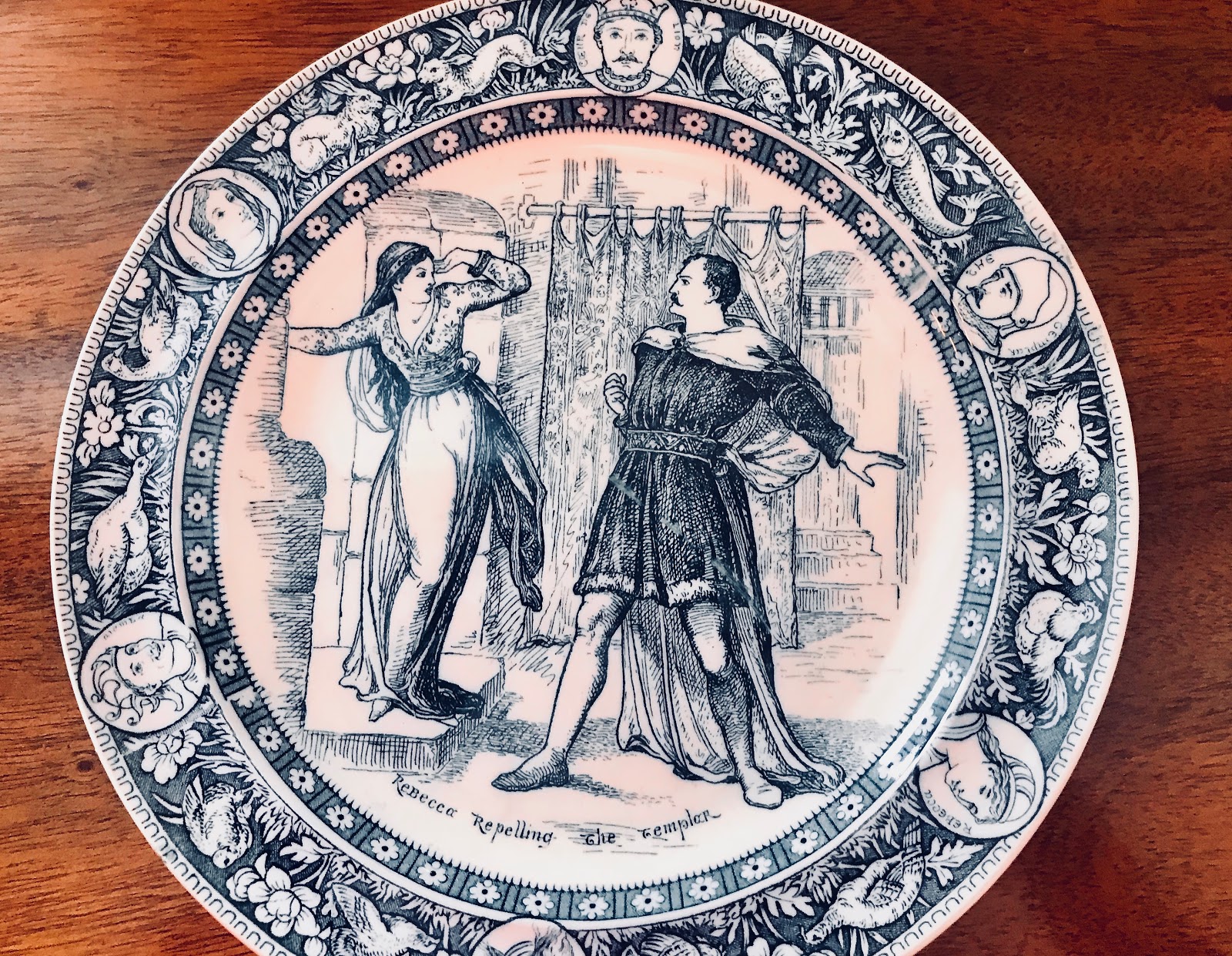
| "Rebecca and the Templar" 10" dinner plate Ivanhoe pattern, Wedgwood, 1880
Rebecca Gratz was celebrated in her lifetime and revered after her death as the inspiration for the character of Rebecca, the beautiful Jewish girl in Walter Scott's historical novel Ivanhoe. As such she became a role model for Jewish women and a figure of romance to the larger community.
The problem today with discussing her association with the character is that no one has read Ivanhoe in 50 years. Even though some are still familiar with the title and can recall it as a story about medieval England, their knowledge comes from a film version rather than the book itself. No one has firsthand experience of the Rebecca of the novel and we are too far away from Ivanhoe's publication date to have any idea of the impact it had on 19th-century readers. So, before we look into the Gratz link, we have to understand how a novel could have the power to change a woman's life. Ivanhoe was published in December 1819, in three volumes, 1000 pages long. Overstuffed with characters and plot lines, it is too much to summarize (see the Wikipedia synopsis) but here is a taste: 12th-century England -- a Saxon knight, Wilfred of Ivanhoe, just returned from the Crusades -- a Norman Knight Templar -- Jews in constant peril -- a tournament -- Rowena, Ivanhoe's childhood sweetheart -- two abductions -- a battle -- Rebecca, a "Jewess" (Scott's word) -- Robin Hood and Friar Tuck -- an attempted sexual assault -- an accusation of witchcraft -- trial by combat -- Good King Richard the Lionhearted -- Bad Prince John -- a host of Norman knights -- lots of Saxon servants and peasants -- a bittersweet ending. This melange of action and romance, vividly portrayed by Walter Scott, turned out to have universal appeal. The publisher set a price on Ivanhoe which was higher than that put on any of Scott's earlier works. Nevertheless, copies seem to have flown out of the bookshops and into the hearts of the British reading public. The same would occur in the United States within a few months and soon after, as translations were produced in the major European languages, Ivanhoe would become an international bestseller. In fact, the public's appetite was so great, the book alone could not satisfy it. The first plays based on the novel appeared on the London stage within three months of its publication. There would be at least 25 theatrical versions performed in Britain over the next decades, some of them running concurrently. Composers across Europe produced numerous operas over the same period, so that it was possible to hear Ivanhoe in English, French, German, and Italian. Painters found the novel irresistible as a source of inspiration. More than 100 paintings of scenes from Ivanhoe would be produced in the 19th century; at least 30 paintings of Rebecca were exhibited in London between 1830 and 1850. Eugene Delacroix alone made a series of lithographs and painted four oils based on Ivanhoe. In the 1850's he drew up a list of 20 more scenes from the novel which would make good paintings, but died before he could execute any of them. Ivanhoe played a role in the revival of interest in the Middle Ages, contributing to the growing popularity of the Neo-Gothic in architecture and furnishings. The novel also had an impact on cultural politics: the Eglinton tournament based on Ivanhoe took place in Scotland in 1839, attracting more than 100,000 people. It was ridiculed by the Whigs (the progressive political party) who saw it as Conservatives cosplaying in support of (really) old values and reveling in an outmoded and romanticized version of aristocracy. In the United States, readers throughout the country loved Ivanhoe, but only in the South were tournaments inspired by the novel a form of popular entertainment from the 1840's to the 1880's. With Ivanhoe Southerners could see themselves as heirs to a traditional feudal society, chivalric and superior to the peasants in the industrialized North. When Mark Twain blamed Scott for starting the Civil War, his overstatement was amusing but he wasn't exactly joking. After the Civil War Ivanhoe became a symbol of the South's lost way of life, and helped to foster the "moonlight and magnolias" version of southern history which downplayed the brutal slave system which supported that past. (I do not think it is a coincidence that one of the Ku Klux Klansmen in Spike Lee's 2018 movie BlacKkKlansman is named Ivanhoe.) Although Ivanhoe picked up this unlooked-for political and cultural baggage along the way, for most people it remained an exciting story appropriate for the whole family. The most telling evidence of how deeply Ivanhoe had been baked into Anglo-American popular culture comes from Wedgwood, famous for its bone china and Jasperware. Around 1880 the company was casting about for a new pattern to be used in its cheaper and sturdier stoneware line -- something which would appeal to the mass market. The choice was Ivanhoe, still going strong 60 years after its publication and recognized by virtually everyone who was literate. More than 20 scenes from the novel appear on various pieces in each set. The pattern was a success throughout the British Empire and in the United States. Wedgwood continued to produce it for nearly a quarter of a century, and several generations of children learned about Ivanhoe from their breakfast plates. (There are plenty of pieces to be seen on eBay, a tribute to the pattern's popularity.) There is much more evidence, which I am sparing you, that Ivanhoe was not just another novel. It was a literary and cultural phenomenon, as well as a story beloved by readers of all ages. To be associated with this book was to arouse the intense interest of the public. To be identified with Rebecca, the novel's most appealing character, brought not only celebrity, but adulation. Next we will look at Scott's Rebecca and see why readers, especially women readers, found her so compelling. (My main source for the information about Ivanhoe was: Ann Rigney, The Afterlives of Walter Scott: Memory on the Move. Oxford University Press, 2012. Thank you to Jesse Rosenberg, Associate Professor of Musicology, Northwestern University, who gave me information about the Ivanhoe operas.) |
Showing posts with label Ivanhoe. Show all posts
Showing posts with label Ivanhoe. Show all posts
Tuesday, October 16, 2018
Rebecca Gratz & Ivanhoe. 1. Not Just Any Novel

Tuesday, November 17, 2009
Washington Irving, Rebecca Gratz & an Unwanted Suitor
Rebecca Gratz's romance with Samuel Ewing, a Presbyterian, ended with her refusal to marry him because of the difference of religion. This is the stuff of legend. Yet, if Rebecca was so charming and lovely, you might think that she would have had at least one other suitor, and you would be correct.
Isaac and Reyna Moses of New York City, old friends of Rebecca's parents, had three sons just the right age (five to ten years older) for the three Gratz sisters still at home at the beginning of the nineteenth century. The young men looked great on paper, scions of a wealthy Jewish family well-known to the Gratz's and already active in the family business. But somehow they did not please the Gratz girls.
Rebecca had spent the winter of 1805-06 in low spirits, having broken with Ewing the previous August, and in April of 1806 her family eagerly sent her off to visit her best friend Maria Fenno Hoffman in New York for a change of scene. About three weeks after she arrived, Rebecca received a letter from her younger sister Rachel who had urgent news from a friend: M.L. (short for Moses Levy), the middle Moses son, was upset because several evenings before at Maria's house, Washington Irving had come in just as he was about to propose to Rebecca. Rachel knew that Rebecca had no interest in this proposal and worried that M.L. would interfere with the her sister's enjoyment of New York. Her advice to Rebecca for avoiding another attempt: "Keep Washington with you as you have done before" [my emphasis].
When Maria Fenno had married Josiah Ogden Hoffman in 1802, Washington Irving was desultorily studying law in Hoffman's office, and although he had little talent for legal matters, he had other gifts -- conversation, charm, good humor--which made him a welcome guest at the Hoffman home. In the spring of 1806, Irving had just returned from eighteen months in Europe and it was at this time that he was introduced to Rebecca.
For her part, Rebecca was delighted with Irving, calling him "the most pleasant young man I have met" in New York. Elsewhere she gave an expanded description of him at a social gathering: Mr. Irving, she wrote, "made puns -- told stories -- wrote poetry... he became quite agreeable to the whole party." Washington provided the liveliness and fun which Rebecca needed. There is no hint of romance on either side. As Maria Fenno Hoffman's close friend, Irving would have been informed about Rebecca's recent romantic history. Besides, he was two years younger than Rebecca and without a profession. In this situation the two could quickly settle into a relaxed relationship, unimpeded by the uncertainties which could blight budding friendships between men and women.
All this must have happened quickly if they were already partners in deception against M.L. (and possibly other unwanted suitors). Irving was too socially adept not to realize that Rebecca was sometimes using him as a shield and was gallant enough to spare a kind young woman from unwanted attentions she could not politely avoid by herself. In years to come their friendship would continue in New York and also at the Gratz house in Philadelphia. It was a very real relationship, better characterized as cordial than as intimate. The legend of Rebecca Gratz as the inspiration for the character of Rebecca in Scott's Ivanhoe rests on the undocumented story that Irving vividly described her to Walter Scott whom he visited in 1817. He was certainly capable of doing that -- whether he did or not is another question.
As for poor M.L., he never married. In a letter from 1802 Rebecca gives us a strong hint as to why she was not interested in him when she tactfully describes his enthusiasms: [M.L] "is certainly the most romantic young man in the boro. He constantly keeps sacking his imagination for omens and wonders--where other people would see nothing extraordinary." "Romantic" here is not "flowers and candy" romantic. This was the Romantic Age, and one of the earliest emanations of the romantic sensibility was an interest in the supernatural (omens, ghosts, etc.). Rebecca was more comfortable in the Age of Reason. Her highest compliment about Samuel Ewing was that he was a "sensible, agreeable companion" although she also added that he was "rather romantic." Rebecca found a little romanticism acceptable in an essentially rational man, but the thought of spending one's life with a man whose major interests in were omens and ghost stories must have been most unappealing to her.
(Rebecca's letters from 1806 are from the Gratz Family Collection, Manuscript Collection No. 72, at the American Philosophical Society. Her letters from 1802 are from the Miscellaneous Manuscripts Collection at the Library of Congress.)
Subscribe to:
Posts (Atom)
