Tuesday, March 22, 2011

Arcadia and History

I just saw a new production of one of my favorites, Tom Stoppard's Arcadia, and I am still bedazzled. The play deals with order v. chaos, classicism v. romanticism, logic v. intuition, and that's just scraping the surface. Given its themes, I am not sure how it happens (Mr. Stoppard has famously written of the theater, "It's a mystery"), but in the course of the play, witty conversation, brilliant ideas, hilarity, tears and, if you're lucky, a moment of transcendence all ensue.

The play takes place in one room of an English country house, but at different times -- 1809-1812 and the present, with scenes alternating between the two periods. Much of the hilarity has to do with a modernday professor, armed with a few documents, who theorizes about events which occurred at the house when Lord Byron visited there in 1809 . The audience knows exactly what happened, and we delight in how very wrong the academic gets it.

This time around, this particular aspect of the play hit a little closer to home than ever before. Two weeks ago I presented my ideas at the Rosenbach Museum & Library about what happened when Washington Irving and Walter Scott had a chat at a Scottish country house in the late summer of 1817 (similar, isn't it?). I was explaining how Rebecca Gratz might have become the topic of conversation between the two literary men. It has long been a legend that Irving's description of her to Scott inspired the character Rebecca in Scott's novel Ivanhoe; I provided a historical context which lent more credence to the story.

Arcadia served as a reminder of how past the past is, how we will never really know. This can be a salutary reminder of the limits of "expertise," but it also casts the pursuit of knowledge as an often futile exercise. Fortunately, the play provides a response to this dilemma. In the second act a scholar and a scientist are arguing about the ridiculous triviality of each other's specialties, when another character breaks in with, "It's all trivial....It's wanting to know that makes us matter. Otherwise we're going out the way we came in."

So we want to know, but we can never know. We're doomed to failure and yet we keep trying to make sense of things, sometimes discerning patterns in history and nature, sometimes creating and imposing patterns on the same. It's a human thing, and if I cannot acquire or pass on perfect knowledge, I may still see further, though through a distorted lens, than I would have done otherwise. In this blog, I'm just letting you know what I think I've found and why I think it's true. I hope it will be of some use to you.

Tuesday, March 15, 2011

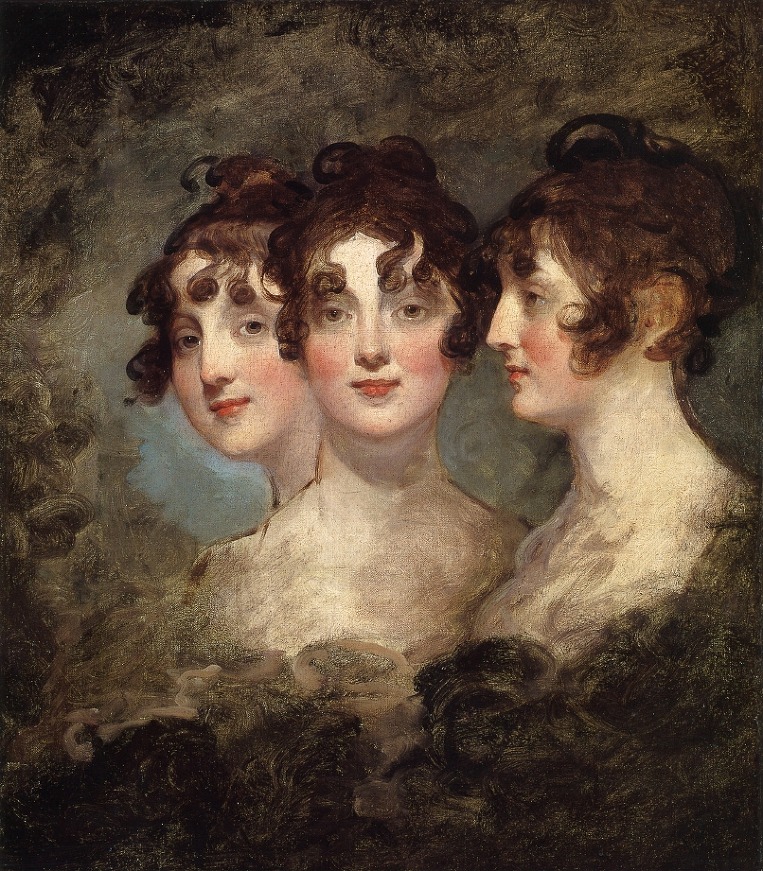
Beautiful Betsy Bonaparte

Elizabeth (Betsy) Patterson, shown above in three views by Gilbert Stuart, was the daughter of a wealthy Baltimore businessman. In 1803 when Jerome Bonaparte, the youngest brother of Napoleon, came to the United States, he met Betsy at a ball, and despite her father's apprehensions, they were married before the end of the year by Archbishop Carroll of Baltimore.
Jerome already had celebrity status in America just by being a Bonaparte, and his beautiful bride enhanced his luster. Betsy would cultivate a celebrity of her own by wearing fashions so diaphanous they hardly hid her nakedness. (For more information about the styles of the day, see "Women's Fashions, 1800. Part 1.")

Napoleon, who had dynastic alliances planned for his relatives, was not amused by his brother's activities in America. The couple however was enjoying a honeymoon, touring a number of American cities before setting sail for France to plead with Napoleon to accept their marriage. On April 21, 1804, they rolled into Philadelphia, where they stayed for a few days across the street from the Gratz house.

A measure of the excitement they stirred: even the cool Rebecca Gratz went to the window to view their arrival. Solomon Moses, who was visiting the Gratz's, had no compunctions about gawking at the open front door. But while Rebecca was curious, she was not envious. Thinking of Mrs. Bonaparte, she wrote, "Last year she could go anywhere unnoted."

If you try to name famous women of antebellum America, you will discover not celebrated women but controversial ones: Lucretia Mott, the abolitionist; Elizabeth Cady Stanton and Susan B. Anthony, feminists; Margaret Fuller, a Transcendentalist and intellectual, and of course Harriet Beecher Stowe. Only Dolley Madison achieved in the course of her long life general approbation. It is no wonder that the idea of celebrity held no allure for Rebecca.

After her initial look, Rebecca decided the Bonaparte's would just be a nuisance. She expected that "loungers" would soon appear in the street and on the sidewalks. She also noted that it was likely that the Gratz's would receive an unusual number of visitors as long as the couple was in the vicinity.

Jerome and Betsy Bonaparte sailed for France a short while after their stay in Philadelphia, but only Jerome was permitted to go ashore. Betsy went to England to give birth to a son and await her husband's return. She never saw him again. When Napoleon could not bully the Pope into annulling the marriage, he annulled it himself and married Jerome off to a German princess.
Betsy Bonaparte returned to America with her child and eventually was granted a divorce by the Maryland legislature. After the fall of Napoleon, she tried to interest the Bonapartes in granting her and her son financial support but failed completely. As an heiress herself, Betsy was not looking for money so much as recognition of her son's legitimate place in the Bonaparte family. Betsy never remarried, resumed her role in America's high society and showed that she could take care of herself: she invested her inheritance wisely, lived into her 90's and died a millionairess.

(Rebecca's letter to her sister Rachel is in the Gratz Family Collection, Manuscript Collection No. 72, at the American Philosophical Society.)


Monday, March 7, 2011

Revision: The Rebecca Gratz Club

I have revised my earlier post on the Rebecca Gratz Club to reflect new information I recently came across. To see the revised version, click here.

Friday, March 4, 2011

March 4, 2011: Rebecca's 230th Birthday

It was the custom in Rebecca Gratz's day for family and friends to offer toasts on birthdays. So if you are lifting a glass today, kindly remember our Becky with a toast to her memory and the fine example she has set us.

Tuesday, February 15, 2011

Ivanhoe, Rebecca & Washington Irving at the Rosenbach

At 6 p.m. on March 3, 2011, Brian Jay Jones, the award-winning biographer of Washington Irving, will be joining me at the Rosenbach Museum and Library for a speculative discussion about the origins of Sir Walter Scott's novel Ivanhoe.

According to literary legend, Irving, on a visit to Scott in 1817, told him about Rebecca Gratz, and from this conversation Scott developed the character of Rebecca, the lovely Jewish maiden who is the moral center of his medieval romance Ivanhoe.

Could the legend be true? A friendship between Irving and Gratz can be documented as can Irving's visit to Scott.
Beyond that? Brian and I will be investigating the length and depth of the Irving-Rebecca friendship, the qualities which Rebecca Gratz and the fictional Rebecca had in common, Irving's personal charm and powers of description and if an American Jewish woman could have become the focus of conversation between two literary men in Scotland in the late summer of 1817.

It should be an interesting evening for Rebecca Gratz aficionados -- and, I think, a wonderful opportunity to learn about America's first man of letters, Washington Irving. (That's him, pictured above, and I ask you, don't you want to know more?)

For more information about the event, please click here.


Tuesday, February 8, 2011

An Insolent Servant

There is an interesting fragment in a letter from Rebecca in Baltimore in 1803, helping her eldest sister Fanny Etting with a new baby (again), to her younger sister Rachel in Philadelphia:

"Peter's insolence is insufferable. I hope Brother will take means to punish him and preventing his daring to repeat it....more advisable to send him to sea or some distant place than to imprison him....[Rachel should not have to be] molested with the sight of him."

Whatever Peter did, he certainly did not touch Rachel or he would have already been in jail. His offense was verbal, perhaps a declaration of love, which would have created an extremely awkward and probably intimidating situation for a young woman of sensibility. Or the incident might have arisen from Rachel's anxieties which sometimes led her to make rather extraordinary demands on those around her. Outsiders, even the gentle, lovable Matilda Hoffman lost patience with her; she wrote that Sally Gratz, Rebecca's older sister, had been "detained here sometime longer than she expected by Rachel's having a pain in her little finger which made it quite necessary for Sally to stay with her" [the emphasis is Matilda's]. The Gratz family as a whole was very accommodating to Rachel but a servant observing this behavior over time might have been driven to make a few choice remarks about it.

Whatever the cause, Rebecca ends the subject in her letter with a judgment that it is all "insignificant" and that Rachel should "try not to think about it."

Of course, it was significant for Peter who was an indentured servant or a redemptioner. We know this because he is not simply fired, and also by the fact that his employer can send him to prison for something which wasn't necessarily a legal offense. Instead, Simon Gratz, the eldest brother who, since his father's illness, had been head of the family, would have to find other work for him. Fortunately, the Gratz's had lands and business interests away from Philadelphia. We must assume that Peter worked out his time somewhere else.


(Rebecca's letter is in the Gratz Family Collection, Manuscript Collection No. 72, the American Philosophical Society. Matilda Hoffman's letter is quoted in Stanley Williams's Life of Washington Irving.)


Tuesday, February 1, 2011

A Pregnant Servant

The reason this story survives is because the teenage Gratz sisters at home in 1798 developed a relationship with the family maid, who was probably about the same age.

In September of that year, Rebecca was in Baltimore helping out her eldest sister Fanny Etting who had a new baby. The rest of the Gratz family, along with their servants, had just moved to Lancaster to escape a yellow fever epidemic raging in Philadelphia. It must have been at this point that Alley, the maid, confided to Rachel, the youngest Gratz sister, that she had been seduced, abandoned and now found herself pregnant.

Rachel wrote to Rebecca about it, and we have her reply. While she is sympathetic, she accepts that the maid's fate has been settled: "Poor deluded Alley," she wrote, was a victim of "inexperience" and having "too good an opinion of a worthless wretch.... [Alley] bartered every prospect of comfort in life for wretchedness and self-reproach. I thought the principles of virtue were too deeply imprest in her bosom ever to be eradicated...had she been educated with a proper respect for virtue, she would have been an ornament to the society of which she was a
member -- but in that rank of life vice is the attendant of ignorance."

Rebecca then assures Rachel that "our honor'd parents' humanity will not abandon her to want in a strange place."

We learn a number of things about the maid and Rebecca from this. First, about Alley, we find that she was not an indentured servant: if she had been she would not have feared abandonment. Her employer would have kept her on but added a year or two to her term of service to make up for the labor lost due to her pregnancy and ensuing motherhood. If her employer thought that an unwed mother was not fit to be around his unmarried daughters, he could rent out her out as a maid to someone else.

Alley, then, was a free woman. She was most likely to have been African-American since African Americans comprised the second largest group (after indentured servants) in the pool of domestics in Philadelphia, circa 1800. But she could also have been from the poor white immigrant class. Because she was free, her condition and its difficulties usually led to a swift termination of her services. Would an employer heartlessly throw a servant out in a strange city? This fear may have been a product of Alley's anxiety, but it is reassuring to find that Rebecca was confident that the Gratz family would not consider such a thing. We have to hope that they did not send her back to plague-ridden Philadelphia, but kept her on as long as the family was in Lancaster.

This incident also tells us something about 17-year-old Rebecca Gratz. She was a rational young woman who thought that through education Alley could have gained an understanding of the dangers she faced and thereby avoided her plight. Like Alley, Rebecca suffered from inexperience. She had not yet encountered reason's nemesis: that complex of emotions which make up romantic love and sexual attraction. When she did, she would emerge with a greater sense of reason's and humans' limitations.


(Rebecca's letter is in the Gratz Family Collection, Manuscript Collection No. 72, the American Philosophical Society.)


Powered by WebRing.